It’s the Spring ‘Growing’ Season!
It’s time to ‘Spring Clean’ your plants and clean up the garden before planting others!
For small perennials like Lantana, Salvia’s, Pentas, Blue Daze etc., simply trim it back to green if they were frozen or frost damaged. If no green, wait awhile until some evidence of that and then trim. They should flush out beautifully with the upcoming warmer temperatures. For woody shrubs like Hibiscus, Allamanda, Bougainvillea, etc, also clip branches back to shape if needed or if frost damaged, trim back to green in the stem or green foliage. Fertilize all your plants after you have done this.
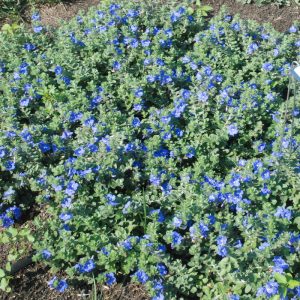
Blue Daze ‘Blue My Mind’
While you’re there, lightly work the soil around your plants to break surface tension for good water and fertilizer absorption into the soil. If your soil has not been amended and your plants performed poorly last growing season top-dress around your plants with a little compost or aged manure. After pruning, weeding, and lightly working the soil- FERTILIZE! This is the ‘growing season’, and plants need food to grow. We cannot stress enough the importance of fertilizing your plants and palms. Florida sand has no nutrient holding capacity and as plants begin to grow, they need nutrients for healthy growth, flowering and fruiting. A healthy plant will ALWAYS fare much better from freeze or insect damage than a weak, nutrient deficient plant.
For years we have recommended the Nurserymen’s Sure Gro slow-release fertilizer blends that will last 3-4 months. It’s what we use on our own home landscapes because it works! For palms, trees and basic landscape shrubs apply the 8-2-12 Palm. For flowering shrubs, flowering trees and perennials apply the 6-8-10 Bloomer. For citrus and fruits apply the 8-4-8 Citrus and Fruit. Never apply the fertilizer on the top of the root ball or crown of plant where burn may occur. It is the ‘feeder’ roots of the plant that is your target to take up the nutrients. Fertilizations should be done March, June and September. After fertilizing, water in well and apply fresh mulch if needed to retain moisture and control weeds.
Some Palms may be looking a little less green or quite brown after the winter with either no fertilizer or the freeze caused damage. You can trim any dead fronds on the palms that may require it. Remember to only trim dead fronds-no green ones. If there is some green on the inside and brown on the outside of the frond, leave it until it completely brown as the green will help get food to the palm. There is nothing you can do to speed the palm up.
You will have to be patient and allow the new growth to replace the burned growth. This is going to take some time. The only thing you can do is fertilize using the Palm Fertilizer and water appropriately.
Fertilization is specific for palms. First, they require an 8-2-12 formulation with 4% magnesium. This is a complete fertilizer as recommended by the University of Florida Extension Service. Since palms are slow growing, their macronutrients need to be slow release. Preferably as close as to 100% as possible. Examples of macronutrients include nitrogen, potassium, and magnesium. Fertilizer that is little to no slow release, could possibly harm your palm. Fertilizer formulations made for turfgrass, for example, are not recommended for use around the roots of palm trees. Doing so will result in a nutrient deficiency that could be fatal. Micronutrients such as iron and manganese need to be in a more soluble form. The only micronutrient that needs to be slow release is boron. Only 0.15% of boron is needed. If it is absent, the palm will suffer from boron deficiency, which also can be fatal.
A baseline application of 1.5 lbs./100 square foot of canopy is needed. For example, if you have a palm tree with a canopy that is 10×10, you apply 1.5 lbs. of fertilizer. When applying the palm fertilizer, spread it out evenly under the entire canopy. Water it in to activate it.
Since IFAS recommends this 8-2-12 formulary and Nursermen Sure Gro is the only source for products that recommend this formula, we will be carrying 8-2-12 from now on. If you still have 8-4-12 you can continue to use it but once our current suppy of 8-4-12 runs out, we will only carry 8-2-12. It can be used in the same manner that you may have used 8-2-12, fertilizing three times per year in our area – spring, summer and fall.
Pruning
When cleaning up your gardens for spring keep these tips in mind:
• Never remove more than one half to two thirds of the foliage at one time to avoid weakening the plant, unless they have froze back to the roots.
• Do not “top” a tree
• Do not remove the branch collar, the portion of the limb next to the trunk
• Do not paint cut branches with wound dressing. This does not prevent decay and can cause more problems!
Why I Shouldn’t Chop My Crape Myrtle?

Crape Murder
Topping a crape myrtle (commonly called “crape murder”) can be very damaging and disfiguring to a crape myrtle. This practice results in profuse growth at the site of pruning and increases susceptibility to disease and insects. Although topping may result in larger blooms, those flowers will grow on thinner, weaker branches that will droop, especially when wet. Topping also can shorten the life of your tree. The end of February was the appropriate time for trimming your Crape Myrtle. We do not recommend shaping your Crape Myrtle until the end of February into early March, before the leaves start to flush out.